F1- Apex Guardian
Cloud-native MLOps infrastructure for 2026 F1 telemetry monitoring and anomaly detection.
Core Impact
“Optimized dashboard latency by 85% and enabled real-time anomaly detection for competitive racing telemetry.”
22+
Concurrent telemetry streams monitored
85%
Lower dashboard latency via caching
Weekly
Automated retrain and promotion
The Problem
F1 telemetry comes in fast and the failures that matter, like thermal spikes and high-speed electrical derating, hide inside the noise across dozens of concurrent streams. You can't watch all of that by hand in real time. I wanted a system that ingests race data on its own schedule, retrains itself, checks for drift, and flags the anomalies without me babysitting it.
The Approach
Why an unsupervised model
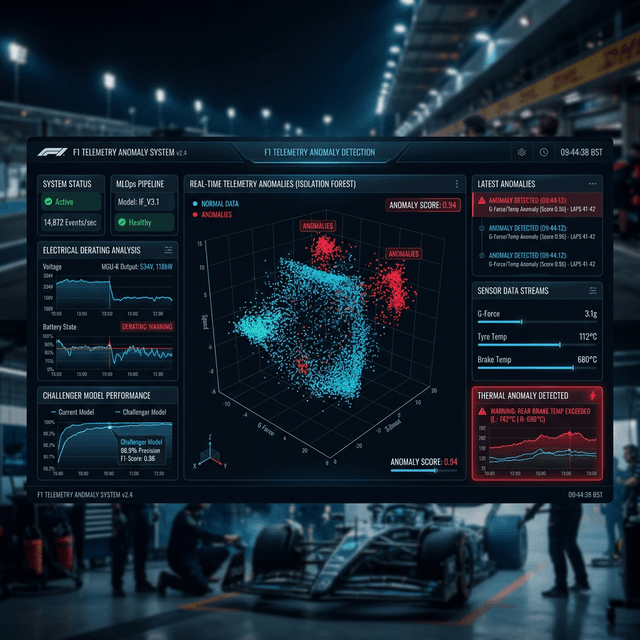
Telemetry anomalies aren't labeled, so I can't train a classifier on them. I used an Isolation Forest that finds the outliers without any labels, which is what lets it catch electrical derating and thermal spikes across 22+ streams at once instead of only the failures I already knew to look for.
Why a weekly Challenger pipeline
Every week GitHub Actions pulls fresh race data through the FastF1 API, runs a Kolmogorov-Smirnov test for distribution drift, and only promotes a new model if it beats the current champion. Full lineage is tracked in DagsHub and MLflow, and no step needs a human.
Why S3 as feature store and registry
Features, model artifacts, and metrics all live in one S3 bucket, so the training pipelines and the dashboard read from a single source of truth instead of drifting apart. It keeps the whole loop reproducible.
Why cache aggressively in the dashboard
The Streamlit app caches loaded models and S3 pulls, which cut dashboard latency and data-fetch time by about 85%. Under race-weekend load that's the difference between a tool people actually use and one that spins.
Technical Deep Dive
Architected a cloud-native monitoring system for F1 telemetry, integrating GitHub Actions for CI/CD automation and AWS S3 as a centralized Feature Store and Model Registry.
Engineered a weekly Challenger pipeline that automates data ingestion via FastF1 API, executes Kolmogorov-Smirnov statistical drift detection, and promotes high-performing models to production using DagsHub/MLflow for full lineage tracking.
Developed and deployed an unsupervised Isolation Forest model to identify high-speed electrical derating and thermal anomalies, achieving real-time diagnostic classification across 22+ concurrent telemetry streams.
Launched a high-concurrency Streamlit dashboard on Hugging Face Spaces, optimized with custom Docker containers and multi-layer resource caching (`@st.cache_resource`) to reduce dashboard latency and S3 data-pull times by 85%.
Systems Analysis Concluded